IR Policy Task Force

The International Relations Policy Task Force invites Schar School sophomore-, junior-, and senior-year students to engage deeply with pressing global challenges. Over the course of the year, students will pursue individual research on a topic of interest, network with subject area experts, and work collaboratively to propose policy solutions. This nonresidential community fits seamlessly into your schedule, allowing you to earn credit towards your degree while you build your research skills and your resume. 

Mosaic tile
Tackle Pressing International Challenges

Gain Critical Skills—And Class Credit

Fall Semester GOVT 399: Great Power Politics (3 credits)
Students will be able to learn the necessary social science skills to conduct their own analytical research on a crucial international relations question of their interest.

Spring Semester GOVT 444: Great Power Politics (3 credits)
Students will mimic the academic publishing process and will go through a Revise and Resubmit (R&R) process, providing peer reviews for fellow classmates’ research paper while revising the final paper students wrote in fall 2025. 

A group of eight students pose for a photo inside a historic meeting room with wood floors, U.S. and Virginia flags, and portraits displayed behind them. Everyone is dressed in business or business-casual attire and smiling at the camera.

Become a Policy Expert

A learning community open to sophomores, juniors and seniors, the International Relations Policy Task Force teaches students how to draft compelling research reports appropriate for different audiences while earning course credit. With this specialized training, students will gain a comprehensive understanding of different policy areas and develop valuable skills to help them secure future employment—and be highly effective in their chosen role. Students will also get connected to former practitioners and policy analysts as well as Schar School alums who work in the field of International Relations in both the public and private sectors.

"Being part of IRTF has been an incredible experience that has contributed greatly to my academic career here at Mason. What sets this course apart is that no two classes are ever the same; every week offers a new networking opportunity with guest speakers from incredibly diverse fields. We’ve explored everything from migration and non-traditional security to ongoing global conflicts, ensuring there is always something that sparks students’ interests. Beyond the classroom, our field trips to DC embassies and international agencies have been deeply inspiring and engaging as well. The most rewarding part for me, however, has been the year-long research project. It has allowed me to develop rigorous, professional-level research skills while focusing on my specific interests and has also helped me build a portfolio for my future career. I truly cannot recommend IRTF enough to anyone looking for unique and experiential learning opportunities in the International Policy field."


Valeria Aguilar Blanco, IRTF '26

A smiling young woman with long dark hair stands indoors near large windows. She is wearing a sleeveless, light-colored, button-front top and a small necklace. The image is framed by a rounded green border, with a yellow speech bubble containing quotation marks in the top-left corner.
A group of students pose for a photo inside the World Bank Group Publications center, standing in front of bookshelves filled with reports and publications. Most are wearing visitor badges and business or business-casual attire while smiling at the camera.

Fulfill Requirements for Your Degree

The IR Task Force fulfills requirements in the following concentrations:  

  • Political Science and International Politics (formerly Government and International Politics)
    • Comparative Politics
    • International Relations
    • Political Analysis
    • Public Policy and Administration  
  • Public Administration
    • Economic Policy Analysis
    • Public Policy 

A Memorable Year

Past events have included:

  • In class guest speakers such as LTC Matt Kuhlman, Ph.D., an Army Foreign Area Officer for Sub-Saharan Africa, Amb. Piper Campbell, and Dr. Andrew Taffer, Research Fellow with the Center for the Study of Chinese Military Affairs within the Institute for National Strategic Studies (INSS), and Dr. Anita Kellogg, Assistant Professor at the Dwight D. Eisenhower School for National Security and Resource Strategy at NDU.
  • Customized field trips to notable sites such as The Pentagon, the Organization of American States, the Australian and Polish Embassies, the World Bank, and BluePath Labs.
Students and a guest speaker pose for a group photo in a classroom with curved conference tables. The group is dressed in casual attire and smiling at the camera after a discussion or class session.

LC Campus to Career helps Schar School Learning Community students prepare for life after college. Students can join networking events, career workshops, and sessions that explore different jobs and career paths. The program also offers chances to meet alumni and get guidance on applications and entering the job market.

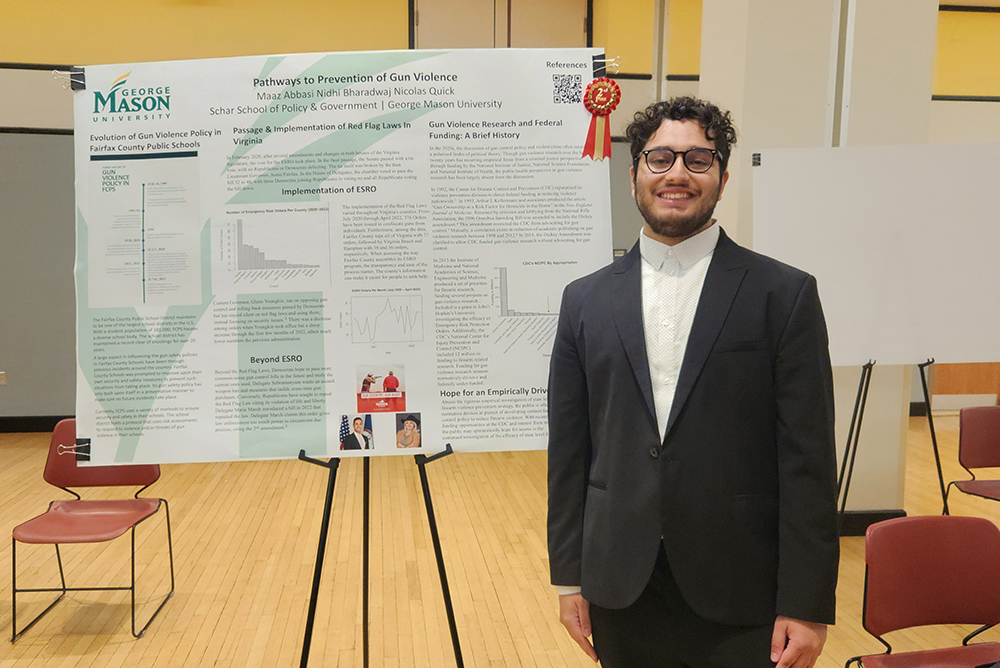
Former IR Task Force students presenting their individual policy briefs

Featured Student Policy Analyses

2025–2026 Academic Year

Students in the International Relations Policy Task Force Learning Community research emerging international issues and develop policy recommendations through concise policy briefs. The examples below highlight the type of work completed by students during the 2025–2026 academic year.

Moon Race: Recommendations for a New Era of Space Exploration

As renewed interest in lunar exploration reshapes international relations, this policy brief examines how competition between the United States and China is influencing the future of space governance. The analysis explores the competing Artemis Accords and International Lunar Research Station initiatives, considers how countries such as Thailand and Senegal have navigated both partnerships, and offers recommendations for strengthening international cooperation and modernizing space law.

Topics: International Relations • Space Policy • International Law • U.S.-China Relations

Read the Full Student Policy Brief

Overview
USAID’s retreat represents a decisive rupture in U.S. foreign policy by removing a critical
instrument of American soft power at a moment of instability. This paper examined how the
withdrawal reshaped U.S. geopolitical influence in Southeast Asia and iterated the consequences
that extend beyond the loss of humanitarian capacity. USAID had served for over a decade as the
United States’ main mechanism for engaging with Myanmar’s population, supporting civil
society, enabling independent media, and funding public health systems, all while facilitating the
country's path towards democratization.

Recommendation #1
The consequences of dismantling USAID’s operations in Myanmar highlight a broad structural
issue in U.S. foreign policy. To prevent future geopolitical vacuums, creating insulated, longterm
funding mechanisms would enhance U.S. credibility. This includes statutory protections
that prevent abrupt termination of major overseas missions. Legislation that designates core
USAID functions, such as humanitarian pipelines and country-specific missions, as
congressionally mandated would require legislative approval rather than executive discretion
alone to suspend or dissolve them. Such protections would ensure that foundational aid structures persist across changing administrations and shifting political priorities. Making critical USAID  functions less vulnerable to partisan swings and volatile election cycles would preserve the
continuity in U.S. engagement and protect civilians around the world who depend on these
programs and maintain soft-power dynamics in strategically contested regions.

Recommendation #2
The vacuum left behind in Myanmar demonstrates the risks associated with abrupt withdrawals
from politically unstable regions. The United States should establish a policy of maintaining a
baseline humanitarian and diplomatic presence in politically unstable regions, even during
periods of domestic political transition. In the vacuum left behind in Myanmar, China quickly
consolidated its influence through humanitarian assistance, infrastructure investment, and
governance programs, effectively replacing USAID’s core functions. This shift illustrates that
USAID wasn’t solely an aid agency, but a vehicle for relationships, visibility, and trust that are
central to soft power. Withdrawing it doesn’t just reduce aid but eliminates U.S. presence
altogether and cedes strategic ground. Maintaining baseline engagement for high-risk regions
regardless of administration priorities would ensure that the United States retains influence and
credibility in strategically contested areas before, not after, a vacuum forms.

Recommendation #3
The broader implication of this drastic shift extends beyond Myanmar. The dismantling of
USAID signals a retreat from the tools that enabled the United States to exert influence without
coercion and to maintain credibility as a benevolent power. In response, the United States must
actively compete with China in soft power domains, including humanitarian assistance,
education, and civil society partnerships. In practice, this means restoring funding to U.S.-backed
independent media programs, expanding educational opportunities like university partnerships,
and supporting civil society organizations in politically unstable regions. Without sustained
engagement in these areas, the U.S. risks ceding long-term influence in strategically important
regions such as Southeast Asia.

These recommendations aim to restore U.S. credibility and rebuild soft power in a region as
strategically critical as Southeast Asia. Maintaining a sustained presence is essential to
preserving influence. The decision to retract USAID has already diminished U.S. influence,
creating space for its greatest competitor, China, to expand its role.

USAID's Retreat and U.S. Soft Power in Myanmar

Student Policy Brief

This policy brief examines the geopolitical implications of USAID's withdrawal from Myanmar and its impact on U.S. influence in Southeast Asia. Drawing on recent developments in the region, the analysis considers how humanitarian assistance contributes to American soft power and presents recommendations for maintaining U.S. engagement in strategically important regions.

Topics: Foreign Policy • Southeast Asia • International Development • Strategic Competition

▼ Read the Full Student Policy Brief

Moon Race: Recommendations for a New Era of Space Exploration
Bottom Line: 

• Great power competition extends to space exploration in the form of competing space initiatives: the Artemis Accords and the International Lunar Research Station.
• Most states pick a side, but the two exceptions—Thailand and Senegal—have a history of hedging their relations with the U.S. and China.
• International space initiatives should remain international; states shouldn’t be forced to choose one side or the other, or appease both, to build space exploration norms.

Background: International space law is comprised of four founding documents, which haven’t been updated since 1974. These documents don’t account for new conflicts and developments in space exploration, such as the concern over lunar resource commercialization and international space initiatives.

The Artemis Accords (Accords) and the International Lunar Research Station (ILRS) are non-binding principles of space conduct open to all states. The Accords are U.S. sponsored and a prerequisite for joining the Artemis Project. The ILRS are China sponsored and requires all signees to participate in joint space activities.

Most states have sided with one or the other, with a noticeable pattern of authoritarian countries preferring the ILRS over the Accords. However, there are two exceptions: Thailand and Senegal signed with both. A survey of past historical behavior points to Thailand and Senegal’s pattern of hedging relations as a possible explanation. It’s likely that other states may follow their example as space exploration becomes more feasible.

However, it’s imperative that international collaboration on lunar exploration remain international. Current and future space actors must have an open path to space exploration, and the UN Office of Outer Space Affairs should help facilitate this goal.

Recommendations:
1) Revise the “International Cooperation for the Peaceful Uses of Outer Space”
• The current version has not been updated since the 1970s and must be broadened to encompass the modern and future contexts of space industry development.
•One way is to create provisions that address new conflicts, such as the legality of lunar resource commercialization. Another way is to clarify or update vague terms and provisions, such as a detailed understanding what “national appropriation” of celestial bodies entails. International space law must be forward-looking to accommodate future space context, with enough flexibility to litigate novel scenarios, while remaining a structured, legal document.

2) Space Initiative Registration System
In the meantime, the UN should keep track of activities that new space initiatives conduct. Using the Register of Objects Launched into Outer Space, the UNOOSA should create a register of planned space activities. Just like the existing register, states will report pertinent information to the Secretary-General. This facilitates more communication between initiatives and provides information to address potential legal or technological conflicts, should they arise.
This database should be regularly updated and all provided information should be publicly available. This creates a strong system of accountability from the UN, the public, and fellow states. It also serves as a way to hold states responsible should disputes arise.

Meet the International Relations Policy Task Force Director

A woman in a blue jacket and black shirt stands outside and smiles

Professor Ketian Zhang

For any questions or to learn more, contact: kzhang20@gmu.edu

Meet the Assistant Director of Student Engagement

A woman wearing a black shirt stands inside and smiles

Emilee Duffy
Assistant Director of Student Engagement
eduffy3@gmu.edu